
Automakers turn to turbocharging – which requires premium gasoline – to meet CAFE standards
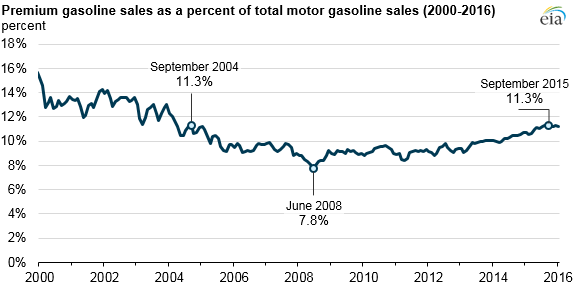
Since 2013, the share of premium gasoline in total motor gasoline sales has steadily increased to 11.3 per cent in Aug. and Sept. 2015, the highest share in more than a decade, according to the US Energy Information Administration.
Although lower gasoline prices may be supporting demand for premium gasoline, the upward trend in sales is more likely driven by changes in fuel requirements for light-duty vehicles (LDV) in response to increasing fuel economy standards, which will have widespread implications for future gasoline markets.
The latest Corporate Average Fuel Economy (CAFE) regulations, which were finalized in Oct. 2012, set automaker LDV fleet-wide fuel economy for model years 2017-21 to a range of 40.3–41.0 miles per gallon (mpg), with standards for model years 2022-25 rising to 48.7–49.7 miles per gallon.
To meet these standards, automakers are implementing a wide range of technical solutions to improve fuel economy.
These solutions include, but are not limited to, weight reduction, conventional engine and transmission efficiency improvements, better aerodynamics, and further development and sale of hybrids and electric vehicles.
One significant trend is engine downsizing coupled with turbocharging.
Smaller, turbocharged engines can be used to raise fuel economy while meeting or exceeding the power and torque of larger engines, allowing engine downsizing and improved fuel economy with little or no performance compromise.
Turbochargers work by using a turbine driven off the exhaust gas to pressurize the intake air.
The pressurized intake air allows a turbocharged engine to produce more power compared with a naturally aspirated engine of the same size.
Because turbocharging forces more air into the combustion cylinder, it increases cylinder pressure and compression.
However, increased compression can lead to an increased risk for engine knock (the premature combustion of fuel), which can damage the engine.
Therefore, turbocharged engines typically require more design and operational features to prevent engine knock than naturally aspirated engines.
The octane rating of gasoline is an indicator of its resistance to spontaneous combustion. The higher the octane rating, the greater the resistance to preignition, the fundamental cause of engine knock.
Use of higher-octane gasoline can offset the increased risk of engine knock caused by increasing engine compression. This higher octane is the reason why premium fuel has historically been required in performance and luxury vehicles that maximize power and torque.
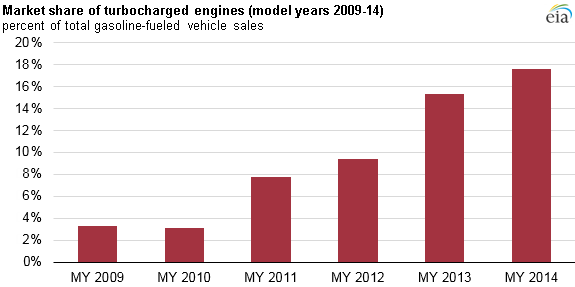
In model year (MY) 2009, turbocharged vehicles accounted for 3.3 per cent of new gasoline-fueled LDV sales. By MY 2014, their share was more than five times greater, at 17.6 per cent of the market.
The growth in market share of turbocharged LDVs reflects increased use of turbocharged engines in popular vehicle models.
In these cases, the turbocharged models have higher fuel economy and more power than the naturally aspirated engines they replaced or supplemented.
This trend is expected to continue, and turbocharged engines are projected to account for 83.3 per cent of the LDV market by 2025.
As automakers produce more vehicles with turbocharged engines, it is likely they will recommend or require more LDVs to use higher-octane gasoline.
Engine models that require premium gasoline are designed to operate only on that fuel, and the use of regular gasoline risks damaging the engine.
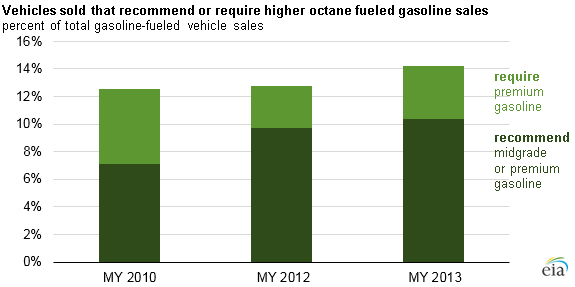
Engine models with premium gasoline recommended will achieve full performance levels using only the higher-octane fuel, but the use of lower-octane fuel will not compromise engine integrity.
In May 2010, 12.5 per cent of the total gasoline-fueled LDV market recommended or required higher-octane gasoline.
By May 2013, higher-octane gasoline-fueled LDVs accounted for 14.2 per cent of the total gasoline-fueled LDV market.
Premium gasoline sales as a percent of total gasoline sales are likely to increase as more car models either recommend or require premium gasoline.
This increase is expected to continue as automakers increase the use of turbocharging as one strategy to comply with increasingly stringent fuel economy standards.